Let’s be honest: getting platform, backend, or infrastructure OKRs to truly line up with company strategy is hard—especially in big companies with long processes and many layers. The work feels indirect (“we don’t own MAU”), dependencies multiply, and goals often devolve into vague slogans.
I’ve been there—as an IT specialist, application architect, and servant leader/Scrum Master—and it was a recurring pain point. That’s why I kept experimenting and put together this guide for teams in the same boat. It’s not a silver bullet, but it will raise the signal and reduce the noise.
Use it as a simple, copy-and-paste starting point to write OKRs that clearly connect day-to-day work to the company bet—without turning your KRs into a task list.
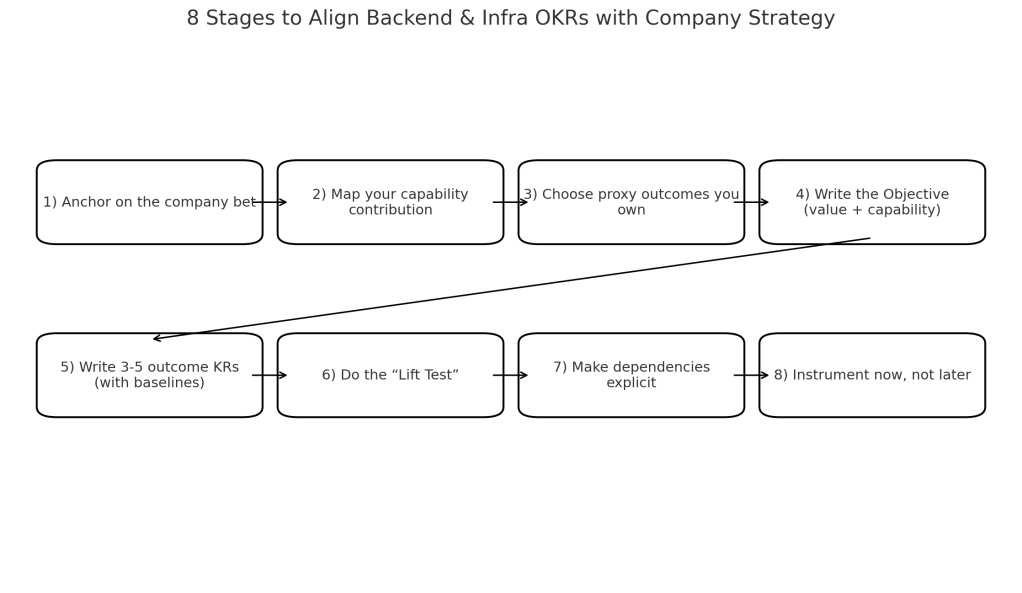
1) Anchor on the company bet
Try to translate the strategy from a slogan into a measurable outcome.
- Slogan → “Expand in APAC.”
- Outcome → “Launch in 3 APAC regions and reach 500k MAU by Q2 while keeping infra cost/MAU ≤ $0.18.”
Why this matters: you can’t align to a sentence; you can align to a number. You may not be able to do it by yourself, but you can consult with your senior managers, they may offer you some ideas. Or try to find supporting numbers from front-ended teams, like, marketing teams etc.
2) Map your capability contribution
List the levers your team actually controls that move that outcome:
- Reliability & SLOs (uptime, error budget, MTTR)
- Performance (p95 latency, throughput)
- Scalability (provisioning time, regions onboarded)
- Compliance/Security (PCI, SOC2, data residency)
- Developer Velocity (lead time for change, deploy frequency)
- Efficiency/Unit Economics (cost per transaction/MAU)
Pick 1–2 primary levers this quarter. Focus beats “everything.”
3) Choose proxy outcomes you own
You don’t own MAU—but you do own leading indicators that unlock MAU.
- “Provision a new region ≤ 1 day”
- “p95 latency ≤ 150ms in APAC”
- “Change failure rate ≤ 10%”
- “Cost per active user ≤ $0.18”
These are your bridges from strategy to daily work. Remember to verify with your stakeholders how much do they value these KRs, and adjust based on their feedback.
4) Write the Objective (value + capability)
Format: “Enable <business value> by improving <capability>.”
- “Enable fast, reliable APAC expansion by industrializing multi-region deployment.”
Plain English. Signal value. Name the lever.
5) Write 3–5 outcome KRs (with baselines)
Cover impact and safety:
- Outcome (what improves)
- Adoption (who uses it)
- Quality/Guardrails (don’t break things)
- Efficiency (unit economics)
Always include from → to → by when format, simple but works.
6) Do the “Lift Test”
Ask yourself below questions:
- If you hit all KRs, would the strategic metric move?
- If not, rewrite until the answer is a confident yes.
7) Make dependencies explicit
Name the “alignment handshake”: which product/domain teams must adopt your platform, and what you need from them.
8) Instrument now, not later
Decide where the truth lives (dashboards, SLOs, DORA, FinOps). No metrics, no OKRs.
A one-page “Strategy → Team OKR” template
Here is one page template you can use when you go through above stages. Copy-paste this into your doc:
- Strategy Anchor: (business outcome + metric/target)
- Our Influence Levers: (reliability, latency, cost, velocity, compliance — choose 1–2 primary)
- Objective: Enable <business value> by improving <capability>.
- Key Results
- Outcome: from → to → by when
- Adoption: who must use it → % or count by when
- Quality/Guardrail: SLO/SLA, error budget, CFR caps
- Efficiency: cost/MAU, cost/txn, reserved coverage, etc.
- Dependencies: teams + explicit handshake items
- Evidence Plan: where metrics live; baseline + target recorded
A 60-minute workshop you can run tomorrow
You may need to workout the OKR with your team members, here is a workshop agenda that you can use to organise the discussion:
- 10 min — Strategy unpack
Rewrite the company bet as 1–2 measurable outcomes. - 15 min — Capability map
Which levers do we own that move those outcomes? Pick 1–2. - 20 min — Draft OKR
Objective (value + capability) + 3–5 outcome KRs with baselines. - 10 min — Lift Test + guardrails
Would these KRs move the strategy metric? Add guardrails. - 5 min — Dependencies + evidence
Who must adopt? Where will we track? Name dashboards.
Realistic examples
Here are some examples for backend/infur teams to refer to.
A) Strategy: Expand globally (APAC first)
Objective: Enable fast, compliant APAC expansion by standardizing multi-region operations.
KRs:
- Cut region provisioning time from 5 days → 1 day (Q2).
- Achieve p95 API latency ≤ 150ms for top 5 APIs in APAC regions (Q2).
- Meet data residency & PCI scope for APAC workloads (all required controls green by Q2).
- Serve ≥80% of APAC traffic via the new multi-region stack (Q2).
- Keep infra cost/MAU ≤ $0.18 in APAC with a live FinOps dashboard (Q2).
Or….let AI do the heavy lifting (smartly)
You don’t need AI to think for you—but it can save time and widen your view:
- Turn slogans into measurable outcomes.
- Suggest proxy metrics you might miss (latency, adoption, CFR, cost/MAU).
- Pull benchmarks & best practices (e.g., DORA, SRE SLOs, FinOps).
- Stress-test targets against historical performance.
Use AI for first drafts and idea generation; keep humans in charge of judgment and trade-offs.
Final thought
Alignment isn’t a poster on the wall—it’s a bridge you build with numbers. When backend and infra teams anchor to the bet, pick the right levers, and commit to measurable proxy outcomes, OKRs stop being “alignment theater” and start moving the business.
If you want, I can adapt the template to your company’s strategy statement and produce a ready-to-share one-pager for your team.

 Lisa Guan's Innovation World
Leave a comment